Here’s something worth thinking about: the average driver makes about 400 decisions per hour behind the wheel. Most of them are so automatic we don’t even notice — adjusting speed, checking mirrors, scanning intersections.
But all it takes is one missed decision, one moment of distraction, one patch of black ice, and everything changes.
That’s exactly why the safety technology coming standard on today’s vehicles is such a big deal. Not because it drives the car for you — it doesn’t — but because it catches the mistakes that humans inevitably make.
If you’re shopping for a vehicle in 2026, here’s a plain-English look at the features worth paying attention to, and why they matter more than any horsepower number or infotainment upgrade.
In This Post
- Quick Reference: 2026 Safety Features at a Glance
- The Ones That Prevent Crashes Before They Happen
- The Ones That Keep You in Your Lane (Literally)
- The Ones That Make Highway Driving Less Exhausting
- The Ones That Help You See Better
- The Ones Working Behind the Scenes
- Standard vs. Optional: What to Watch For
- The Bottom Line
- Frequently Asked Questions
- Sources
Quick Reference: 2026 Safety Features at a Glance
| Feature | What It Does | Active or Passive? |
|---|---|---|
| Automatic Emergency Braking (AEB) | Brakes automatically to avoid or reduce collisions | Active |
| Pedestrian & Cyclist Detection | Identifies vulnerable road users in the vehicle’s path | Active |
| Rear Automatic Braking | Stops the car during low-speed reversing if an object is detected | Active |
| Lane Departure Warning | Alerts the driver when drifting out of the lane | Active |
| Lane Keeping Assist | Gently steers the car back into the lane | Active |
| Blind Spot Monitoring | Warns of vehicles in blind spots; some versions intervene | Active |
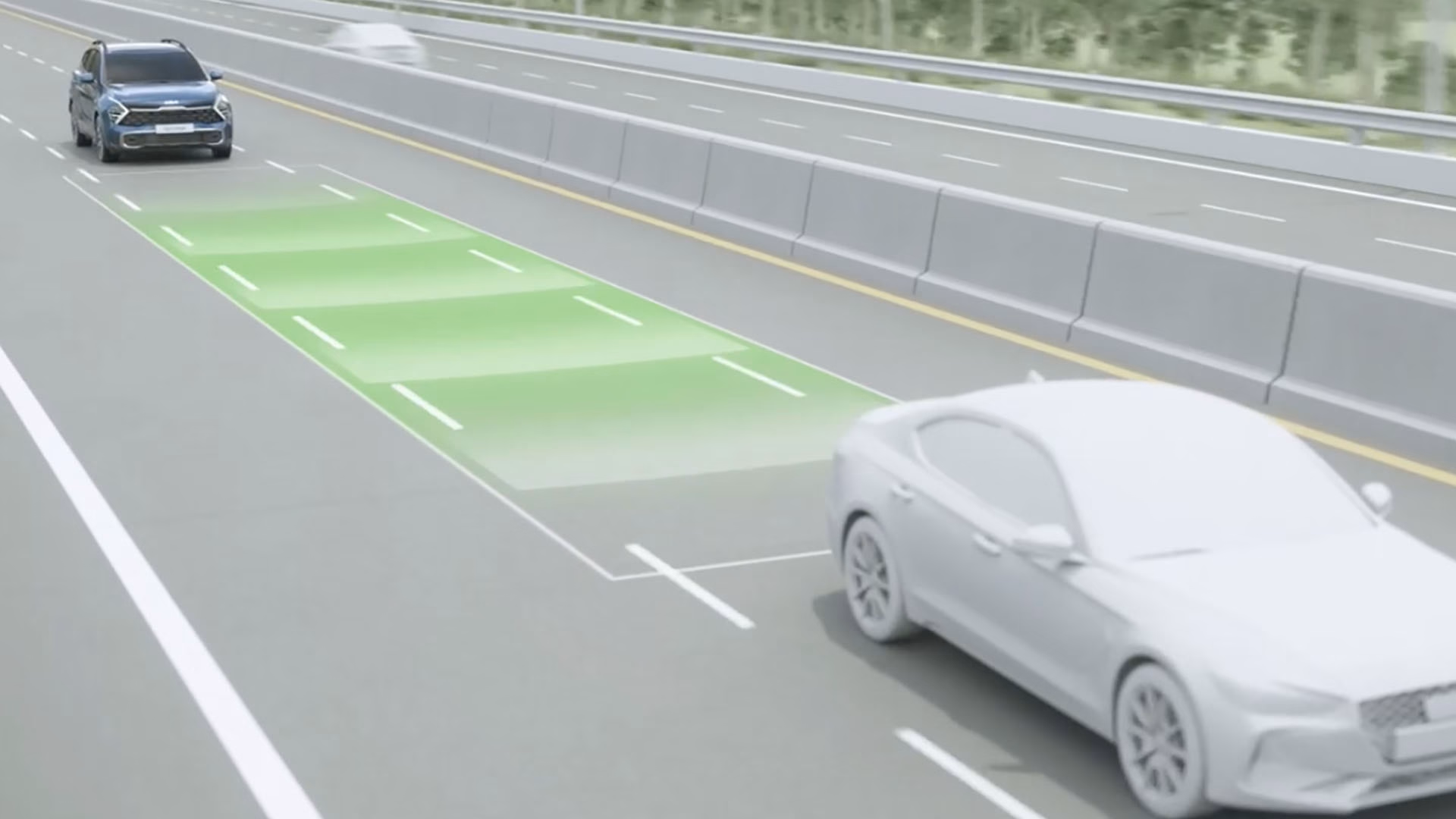
| Adaptive Cruise Control | Adjusts speed to maintain safe following distance | Active |
| Traffic Jam Assist | Manages acceleration, braking, and steering in stop-and-go traffic | Active |
| Intelligent Speed Assist | Alerts or limits speed based on posted speed limits | Active |
| Adaptive Headlights | Pivots beams with steering input for better nighttime visibility | Active |
| 360° Camera with AI Recognition | Identifies and flags hazards around the entire vehicle | Active |
| Head-Up Display (HUD) | Projects speed, nav, and alerts onto the windshield | Active |
| Driver Monitoring System (DMS) | Detects drowsiness or distraction via interior cameras | Active |
| Advanced Airbag Systems | Adaptive deployment based on occupant size and impact angle | Passive |
| Crash-Optimized Body Structure | Engineered crumple zones that redirect energy away from occupants | Passive |
| Tire Pressure Monitoring (TPMS+) | Monitors tire health and flags maintenance needs proactively | Active |
The Ones That Prevent Crashes Before They Happen
Automatic Emergency Braking has been around for a few years now, but the 2026 generation of AEB systems is genuinely impressive. Where older versions struggled at highway speeds or in low light, current systems are far more reliable across conditions.
The basic idea is simple: if you’re about to hit something and you haven’t braked, the car does it for you. AAA found that 2024 model year vehicles with AEB were twice as likely to avoid forward collisions at 35 mph compared to older models. That gap has only widened.
Most new vehicles also extend AEB to include pedestrian and cyclist detection — which matters enormously in urban and suburban driving. Some of the more advanced systems now use triple-camera arrays and can even track the vehicle two cars ahead of you, giving the system more time to react than any human could manage.
Rear Automatic Braking is the behind-you equivalent, and it’s something parents with young kids will tell you they can’t imagine living without. It detects objects during low-speed reversing and stops the car before you make contact. Think:
- A child on a bike darting behind the car
- A shopping cart that rolled into your path
- A low wall or post that didn’t show up in your mirrors
The Ones That Keep You in Your Lane (Literally)
Lane Departure Warning and Lane Keeping Assist sound like the same thing, but there’s an important distinction:
| Feature | What Happens When You Drift |
|---|---|
| Lane Departure Warning | Alerts you — beep, vibration, or visual indicator |
| Lane Keeping Assist | Gently steers you back toward the center of the lane |
On a long highway stretch at 70 mph, that difference could be life or death. Fatigue-related lane drift is one of the leading causes of serious crashes, and these systems are specifically designed for exactly that scenario.
Blind Spot Monitoring has similarly evolved. The early versions just lit up a little icon in your mirror. The newer “assist” versions will actually:
- Nudge the steering wheel if you start moving toward a hidden vehicle
- Apply light braking on one side of the car to guide you back into your lane
- Alert you with an audible warning if you activate the turn signal toward an occupied blind spot
It’s not aggressive — more like a firm suggestion — but in the right moment, it works.
The Ones That Make Highway Driving Less Exhausting
Adaptive Cruise Control deserves more credit than it gets. Traditional cruise control is basically useless in real traffic because it can’t account for other vehicles slowing down in front of you. Here’s how the generations have evolved:
| Generation | What It Can Do |
|---|---|
| Standard Cruise Control | Holds a set speed only |
| Basic Adaptive Cruise | Adjusts speed to match traffic ahead |
| Full Stop-and-Go Adaptive | Brings car to a full stop and resumes without driver input |
For anyone who does significant highway or interstate driving, the full stop-and-go version is genuinely transformative.
Traffic Jam Assist takes it a step further by adding steering into the mix. It’s designed for exactly the kind of grinding congestion that wears drivers out and leads to fender-benders. You’re still in charge, but the car handles the tedious parts.
Intelligent Speed Assist uses GPS mapping and cameras that read posted speed limit signs to either alert you when you’ve exceeded the limit or gently help you comply.
Some drivers find it mildly annoying; others appreciate not having to mentally track speed limits through every school zone and construction corridor. Either way, it’s becoming more common as a standard feature.
The Ones That Help You See Better
Adaptive headlights are one of those features you don’t fully appreciate until you’re driving a winding rural road at night. Here’s what sets them apart from standard headlights:
- Directional adjustment — beams pivot with the steering wheel to illuminate curves before you enter them
- Automatic high-beam control — dims for oncoming traffic so you can run on high beams more of the time
- Intensity adaptation — some systems adjust brightness based on vehicle speed and road conditions
360-degree camera systems have gone from luxury novelty to genuine safety tool. The AI-powered versions now available in many vehicles don’t just show you what’s around the car — they identify and flag pedestrians, cyclists, and other hazards with audible and visual alerts.
High-definition displays and seamless infotainment integration make them far more useful than the grainy backup cameras of a decade ago.
Head-Up Displays keep speed, navigation, and safety alerts projected onto the windshield right in your sightline, so you’re not glancing down at the instrument cluster. It sounds like a small thing until you realize how much safer it is to process information without redirecting your gaze from the road.
The Ones Working Behind the Scenes
Driver Monitoring Systems are becoming more mainstream, and for good reason. Using interior cameras and sensors, DMS watches for:
- Eyes leaving the road for too long
- Head position suggesting drowsiness or distraction
- Hands off the wheel beyond a safe threshold
A gentle alert at the right moment can prevent a tragedy. As hands-free highway driving technology continues to expand, DMS is a critical safety layer — the system’s way of confirming there’s still an attentive human in the loop.
Advanced airbag systems are something most people don’t think about until they need them, which is exactly when you want them to be right. Modern systems deploy adaptively — adjusting based on:
- The size and weight of the occupant
- Whether they’re wearing a seatbelt and how they’re seated
- The angle and severity of the impact
The difference between a well-designed adaptive airbag system and an older fixed-deployment one can be significant in serious crashes.
Crash-optimized body structures — reinforced high-strength steel frames and engineered crumple zones — remain the backbone of vehicle safety even in a world full of sensors and cameras.
All the technology in the world doesn’t replace the physics of what happens when a car absorbs impact energy away from the passenger cabin. This is one reason crash-test ratings still matter and why structural design should be on your checklist alongside the feature list.
Finally, tire pressure monitoring with predictive health tracking might not sound as exciting as the rest of this list, but underinflated tires are a real and underappreciated safety risk. The 2026 generation of TPMS goes beyond just alerting you to low pressure:
- Monitors overall tire health and wear patterns
- Flags potential maintenance needs before a blowout becomes a possibility
- Integrates with other vehicle safety systems for a more complete picture
Standard vs. Optional: What to Watch For
One of the most important things to check when shopping isn’t just which safety features a vehicle has — it’s which trim levels they’re included on. Here’s a general breakdown of where these features tend to fall in 2026:
| Commonly Standard | Often Requires Higher Trim or Package |
|---|---|
| Automatic Emergency Braking | Driver Monitoring System |
| Rear Backup Camera | Head-Up Display |
| Lane Departure Warning | Adaptive Headlights |
| Tire Pressure Monitoring | 360° Camera System |
| Blind Spot Monitoring (some brands) | Traffic Jam Assist |
| Forward Collision Warning | Full Stop-and-Go Adaptive Cruise |
A vehicle that bundles the active safety suite as standard equipment across trims is genuinely safer for the average buyer than one that reserves those features for upper configurations — regardless of brand.
The Bottom Line
None of these features replace an alert, engaged driver — and every manufacturer will tell you exactly that in the fine print.
But the research is clear: vehicles equipped with modern active safety technology get into fewer serious crashes, and when crashes do happen, the outcomes tend to be less severe.
Whether you’re shopping for a practical commuter, a family hauler, or a work truck, it pays to look closely at what’s included and what costs extra. The best car is the one that gets you home every time.
Frequently Asked Questions
Do I really need all these safety features, or are some more important than others?
Not all of them are equal. If you’re prioritizing, focus on Automatic Emergency Braking, Blind Spot Monitoring, and Lane Keeping Assist — those three address the most common crash types. Everything else is a meaningful bonus, but those are your non-negotiables.
How do I know which safety features come standard vs. which ones I have to pay extra for?
Always look at the specific trim, not just the model. AEB, rear backup camera, and lane departure warning are standard on most new vehicles. Features like 360-degree cameras, adaptive headlights, and full stop-and-go adaptive cruise typically require a higher trim or optional package. When in doubt, ask your salesperson to walk through the window sticker line by line.
Are safety features on cheaper cars as effective as the ones on luxury vehicles?
More than you’d expect. Brands like Mazda, Kia, and Honda have made comprehensive safety suites standard across their lineups — sometimes outpacing luxury rivals that charge extra for the same tech. Luxury vehicles tend to get cutting-edge features first, but for the features that matter most day-to-day, price isn’t a reliable indicator of protection.
Should I prioritize crash-test ratings or active safety technology?
Both — they measure different things. Crash-test ratings tell you how well the vehicle protects you during a collision. Active safety tech tells you how well it prevents one. A vehicle that scores well on both is the goal. Strong crash scores with no standard AEB is a gap worth knowing about before you buy.
Can these safety systems malfunction or give false alerts?
Yes. AEB can trigger on shadows or overhead signs. Lane Keeping Assist can get confused by faded lane markings. Blind Spot Monitoring can misread guardrails. False alerts are usually more annoying than dangerous, but they’re a good reminder that these systems assist drivers — they don’t replace them.
Do safety features like AEB and lane assist work in bad weather?
They work, but with reduced effectiveness. Camera-based systems struggle in heavy rain, snow, or fog. Radar-based systems are more weather-resistant but can still be affected by ice buildup on sensors. In severe weather, treat driver assist as a backup — not a primary safety net.
What happens if a sensor gets blocked by dirt, ice, or a cracked windshield?
The vehicle will typically alert you via a dashboard warning, and the affected system will deactivate until the issue is cleared. A cracked windshield should be addressed promptly if it’s in the forward camera’s line of sight. Keeping sensors and camera areas clean — especially in winter — is a simple but important habit.
Do these systems need to be recalibrated after repairs or a windshield replacement?
Yes, and this surprises a lot of owners. Any repair involving sensors, cameras, or radar modules typically requires professional recalibration afterward. A forward camera that’s even slightly off-angle can throw off AEB and lane assist accuracy. Always ask whether recalibration is needed before leaving the shop.
Will these safety features lower my insurance rates?
Possibly. Many insurers offer discounts for vehicles with AEB, blind spot monitoring, and lane keeping assist. The amount varies by provider, so it’s worth a quick call to your insurer before you buy — in some cases the savings over a few years can help offset the cost of a higher trim with a more complete safety package.
Do safety systems require software updates?
Increasingly, yes. Many manufacturers push over-the-air updates that improve system performance — similar to how your phone updates. Vehicles without OTA capability may need a dealership visit to stay current. Don’t ignore update notifications; they sometimes meaningfully improve how a system handles real-world situations.
Can I turn these features off if I find them annoying?
Most of them, yes. Lane Keeping Assist, Intelligent Speed Assist, and driver monitoring alerts are usually adjustable through the vehicle’s settings. AEB is trickier — some vehicles temporarily allow it to be disabled but reactivate it at the next startup. If a feature is triggering constantly and incorrectly, have it checked before disabling it — it may just need recalibration.
What’s the difference between driver assist and self-driving?
In a word: responsibility. Every system available on a mainstream production vehicle in 2026 is a driver assistance system — you are still legally and practically in control at all times. Adaptive cruise, lane centering, and traffic jam assist make driving easier, but they are not self-driving. No consumer vehicle on the market today can handle all conditions without human oversight, regardless of how the marketing language reads.
Sources
- AAA — cited the stat about AEB being twice as likely to avoid forward collisions at 35 mph: https://www.acg.aaa.com/connect/blogs/4c/auto/best-car-safety-features
- NHTSA — the national authority on crash testing and 5-star safety ratings: https://www.nhtsa.gov/ratings/2026-model-year-vehicles-selected-testing-nhtsa
- IIHS — Top Safety Pick ratings and crash test standards: https://www.iihs.org/ratings/top-safety-picks
- Consumer Reports (via Quartz) — their 2026 safest cars evaluation methodology: https://qz.com/safest-cars-2026-consumer-reports
- Focus2Move — Top 7 safety features to look for in 2026: https://www.focus2move.com/the-top-7-car-safety-features-to-look-for-in-2026/