
Navigating the specifics of a vehicle lease can feel like learning a new language, especially when it comes to the lease mileage, the amount of miles you can accumulate on the odometer before turning the vehicle in.
At H+H Chevy, H+H Kia, and H+H Jeep Dodge Ram, we find that the most frequent questions from Omaha shoppers revolve around how lease mileage limits impact their monthly payments and their responsibilities at the end of the term. Understanding these limits is critical because the mileage you choose directly influences the vehicle’s residual value—the estimated worth of the car at the end of the lease.
Our comprehensive guide to lease mileage provides a detailed breakdown of how these limits work, the definitions you need to know, and how to accurately forecast your driving habits in the Omaha metro area to avoid unnecessary costs.

HHCHEVY.COM
Find a great lease deal on a new Chevy at H+H.
Understanding Your Lease Mileage Options
When you sit down to sign a lease at an H+H dealership, you are essentially agreeing to “borrow” a certain amount of the car’s life. Because a car with 45,000 miles is worth less than a car with 30,000 miles, the lease mileage you choose is a primary factor in your payment calculation.
Most manufacturers, including Chevrolet, Kia, and the various brands under Jeep Dodge Ram, offer several standard lease mileage “tiers.” According to Consumer Reports, these tiers allow the lender to predict the vehicle’s depreciation accurately.
Ultra-Low Mileage Leases (5,000 to 7,500 miles per year)
If you live and work nearby and very rarely travel long distances, a 5,000- or 7,500-mile-per-year lease would offer you the lowest possible monthly payment without adding money down. Or, if you lease something like a Corvette and plan to use it for weekend joyrides only, there’s no need to spend extra on miles you won’t use. These leases also maximize the vehicle’s residual value because the car should have very low wear and tear when it is returned.
Low-Mileage Leases (10,000 Miles Per Year)
A 10,000-mile limit is often considered the “sweet spot” for lease mileage. It provides a bit more breathing room than the ultra-low options while still keeping the monthly payment highly competitive. This is the most common term you’ll see advertised in our lease offers at H+H Chevrolet, H+H Kia, H+H Jeep Dodge Ram.
Standard Mileage Leases (12,000 Miles Per Year)
For a long time, 12,000 miles was the industry standard. This tier is designed for the average American driver. In a city like Omaha, where the sprawl can lead to 25-minute drives for even basic appointments, 12,000 miles ensures you aren’t constantly watching the odometer during your daily commute.
High-Mileage Leases (15,000+ Miles Per Year)
If your daily routine involves driving from Elkhorn to central Omaha, or if you frequently take the family to Kansas City for the weekend, a high-mileage lease is a safer bet. While your monthly payment will be higher, it is almost always cheaper to buy these miles at the start of the lease than to pay the overage penalties at the end or be forced to buy out your lease when you weren’t planning to.
Key Definitions: Mastering the Terminology
To make an informed decision on your lease, it helps to be familiar with the terms used by lenders.
Residual Value: This is the projected value of the car at the end of the lease. A higher lease mileage limit lowers this value, which in turn increases the amount of depreciation you must pay for during the lease term.
Excess Mileage Charge: The per-mile fee charged if you return the vehicle with more miles than allowed by your contract.
Lessee: You, the person leasing the vehicle.
Lessor: The financial institution (such as Kia Finance America or GM Financial) that owns the vehicle.
Disposition Fee: A flat fee often charged at the end of a lease to cover the cost of cleaning and reconditioning the car for sale as a used vehicle.
Picking the Right Mileage and Term for Your Omaha Lifestyle
Selecting the right mileage is an exercise in honest self-reflection. According to Leasing.com, many drivers underestimate their annual mileage by failing to account for “invisible” miles—trips to the grocery store, gym, or the multiple school drop-offs that define life for many Omaha families.
Calculate Your Commute
Start with the math. If your round-trip commute to work is 20 miles, that is 100 miles per week, or roughly 5,000 miles per year (accounting for holidays and vacations). If you double that to account for weekend errands and social outings, you are already at 10,000 miles. This leaves very little room for road trips or unexpected detours.
The “Buffer” Rule
It is generally recommended to add a 10% to 15% buffer to your estimated annual mileage. This protects you against lifestyle changes, such as a new job in a different part of the Omaha metro or a change in your children’s extracurricular schedules.
Analyze Your Past Habits
Look at the odometer of your current vehicle. If you have owned your car for three years and it has 39,000 miles on it, you are averaging 13,000 miles per year. In this scenario, signing a 10,000-mile lease because the monthly payment looks attractive would be a financial mistake. You would be better served by a 15,000-mile lease, even with the higher monthly cost.
The Reality of Mileage Overage Charges
Overage charges are the “hidden” risk of leasing, but they are entirely transparent if you read your contract. Most H+H Chevy, H+H Kia, or H+H Jeep Dodge Ram leases will specify an overage rate, usually between $0.20 and $0.25 per mile.
While $0.25 might sound small, the math adds up quickly:
1,000 miles over: $250
5,000 miles over: $1,250
10,000 miles over: $2,500
As noted on Reddit’s r/askcarsales, paying for miles upfront is significantly more cost-effective. When you increase your mileage limit at the start of the lease, you are typically paying for those miles at a rate of roughly $0.10 to $0.15 per mile through the increased depreciation in your monthly payment. Waiting until the end of the lease to pay for them can effectively double your costs.
One common misconception is that you can “buy” more miles in the middle of your lease. As discussed in this Reddit thread, most captive finance companies do not allow you to modify your lease milage once the contract is signed. Your options at that point are to pay the overage at the end, trade the car in early, or buy the vehicle at the end of the lease to avoid the fees entirely.
Strategies for Staying Under Your Limit
If you find yourself approaching your lease mileage limit halfway through your lease term, there are several ways to manage the situation without breaking the bank.
Vehicle Swapping: If your household has two vehicles—perhaps a leased Kia Telluride from H+H Kia and an older commuter car—try to shift more of the long-distance driving to the vehicle you own outright.
Monitor Monthly: Don’t wait for the lease-end inspection. Check your odometer monthly. If you have a 36-month lease with 36,000 miles, you should ideally be at 12,000 miles at the end of year 1. If you’re at 15,000, you know you need to adjust your habits.
The Buyout Option: If you love your vehicle and you’ve gone significantly over the miles, the simplest solution is to buy the car at the end of the lease. When you exercise the purchase option, the mileage limit becomes irrelevant because you are now the owner. This is a common path for Omaha drivers who find their driving needs increased unexpectedly.
Local Considerations for Omaha Drivers
Driving in Nebraska presents unique challenges that can affect your mileage. For instance, the winter months often involve slower travel and more idling, but they also tend to discourage long road trips. Conversely, the summer months often see Omaha residents heading to the Lakes or traveling to Lincoln for Husker games.
When visiting an H+H location, talk to our consultants about your specific driving patterns. Whether you are looking at a rugged Jeep Gladiator for weekend adventures or a fuel-efficient Chevrolet Equinox for the daily grind, we can help you align your lease mileage with the reality of Omaha roads. For more information on choosing between different models, you can check out our DriveHH guide to SUV sizes or our comparison of hybrid vs. gas options.
External resources like Kelley Blue Book also suggest that regional driving habits should dictate your lease mileage more than national averages. In the Midwest, where public transit is limited and personal vehicles are the primary mode of transportation, standard or high-mileage leases are often more practical than the ultra-low mileage offers designed for dense urban centers like New York or Chicago.

HHKIA.COM
Lease a new Kia from H+H in Omaha.
Frequently Asked Questions (FAQs) About Lease Mileage
Can I add more lease mileage after I have signed the lease?
Generally, no. Most lease contracts are fixed once signed. However, some manufacturers allow you to purchase additional miles at a slightly discounted rate before the lease ends, though this is not universal. It is always best to choose a slightly higher limit at the start.
What happens if I return a leased car with fewer miles than allowed?
Unfortunately, you do not receive a refund or credit for unused miles. This is why it is important for your lease milage to be as accurate to your needs as possible; “buying” too many miles results in a higher monthly payment for a benefit you didn’t use.
Does the mileage limit on a lease affect the vehicle’s warranty?
Most new vehicles from H+H Chevy, H+H Kia, and H+H Jeep Dodge Ram come with warranties that cover a certain number of miles. If you choose a high-mileage lease of 15,000 miles per year for 3 years on a vehicle with a 3-year, 36,000-mile warranty, you will likely exceed your warranty before the lease is over, meaning you’ll be on the hook for repairs towards the end of your lease.
Can I trade in my lease early if I’m over the miles?
Yes, you can trade in your leased vehicle at any time. We will evaluate the car’s current market value against the lease payoff amount. If the car’s value is lower than the payoff (partially due to the high mileage), you may have “negative equity” that must be paid or rolled into a new loan.
Can I buy out my lease early if I’m over the miles?
Yes, most lease agreements allow for an early buyout. By purchasing the vehicle from the lender, you terminate the contract and the lease mileage restrictions associated with it. You will pay the remaining lease payments and the residual value.
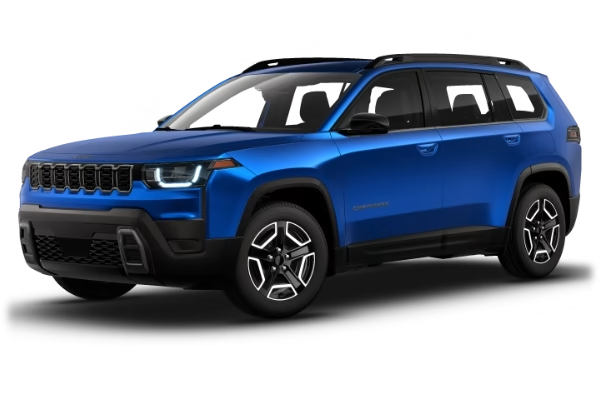
HHJEEPDODGERAM.COM
Find your next lease deal at H+H Jeep Dodge Ram.
Sources
- Guide to Car Lease Terms | Consumer Reports
- changing mileage on lease | Reddit user
- Annual mileage guide | Leasing.com
- How does the mileage limit in a lease agreement work? … | Quora user
- Should You Lease Your Next Car? | Consumer Reports
- Car Leasing Guide: How to Lease a Vehicle in 2025 | Kelley Blue Book®
- How to Choose the Right Car Lease Mileage Option for You | Apple Leasing
- Am I misunderstanding something about lease miles? … | Reddit User